Read the Minutes from Annual General Meeting on October 12 – held electronically with ZOOM – click here.
AGM 2020, October 12
Read the Minutes from Annual General Meeting on October 12 – held electronically with ZOOM – click here.
All EU rules and regulations in one document, this was what the European Ballooning Federation has been working toward for the last 6 years. Easy rules which should be east to find.
These common rules for the EU have now been published and can be found at the EASA website: https://www.easa.europa.eu/sites/default/files/dfu/Balloon%20Rule%20Book.pdf
INCORPORATED AMENDMENTS IMPLEMENTING RULES (IRS) (COMMISSION REGULATIONS)
Incorporated Commission Regulation:
Regulation (EU) 2018/395 Cover regulation Annex I — Definitions (Part-DEF)
Air operations 8/4/2019 Annex II — Balloon air operations (Part-BOP)Regulation (EU) 2020/357
Cover regulation Air operations and Aircrew 8/4/2020
Annex I — Definitions (Part-DEF)
Annex II — Balloon air operations (Part-BOP)
Annex III — Requirements for balloon flight crew licensing (Part-BFCL)
Regulation (EU) 2019/1383 Annex Vb (Part-ML)
Continuing Airworthiness 24/3/2020
Regulation (EU) 2019/1384 Annex Vb (Part-ML) 24/3/2020 Regulation (EU) 2020/270 Annex Vb (Part-ML) 24/3/2020 AMC/GM TO IR (ED DECISIONS)
Any questions or remarks can be addressed to:
European Ballooning Federation
kaa@ballooning-federation.eu
EBF is happy to publish the latest version of the recommendations for General Aviation. This document has been worked out by GA stakeholders (including EBF for ballooning) & EASA. It is only recommendations, not compulsory, but we believe it may be very useful to make a decision before a flight.
Read the recommendation – click here.
EBF has prepared a COVID 19 Protocol for our members to either uses or take as a idea to expand on. It is available to EBF members and is meant to generate ideas and suggestions. If you already have a protocol you may want to read the EBF protocol and compare.
All members are free to use this document.
You are welcome to let us know your comments and suggestions! kaa@ballooning-federation.eu
Karel Abbenes
| Type of flight | When does this type of flight occur? | How is time logged? |
|---|---|---|
| Normal flight | When you have your BPL and you fly a trip (regardless of whether you are alone in the basket or not) in a balloon class you are approved for. | The time is recorded as Pilot in Command by the pilot. |
| Student Pilot under Training (PUT) |
You are in training. |
Time is recorded as Dual / instruction flight. FI (B) records time as Pilot in Command and as FI (B) |
| Training flight | You must have at least one training flight with an FI (B) within the last 48 months prior to the scheduled flight. | Time is recorded as Dual / instruction flight. FI (B) records time as Pilot in Command and as FI(B) |
| Solo | You fly your solo flight during your training. Your instructor follows from the ground. |
The time is recorded as Pilot in Command. FI(B) cannot record flight time. |
| Practical skill test | When acquiring a new certificate privileges for a new balloon class. You fly a practical skill test with an FE(B). |
Time is recorded as Pilot in Command (if you pass). FE(B) records the time as Pilot in Command and as FE8B) |
| Proficiency test | You do not meet the hourly experience requirement or training flight required, so you must have acquired your privileges again. | Time is recorded as Pilot in Command (if you pass). FE(B) records the time as Pilot in Command and as FE(B). |
| Dual (under supervision) | You fly under supervision with an FI(B) (who is the commander/PIC) and you fly at different times during the flight. | You register the time you fly the balloon as Dual. The commander registers the entire flight as Pilot in Command. |
“Flight time” means the total time from the moment the basket leaves the ground for the purpose of taking off until the moment it finally comes to a rest at the end of the flight.
For your information and consideration I attach the EASA recommendations (not compulsory) regarding COVID 19 measures for flights.
They are not specifically written for ballooning, but you can distil from these what you think is needed.
We have proposed to restart commercial ballooning based on these suggestions in the Netherlands. We will know next week if they have the guts to say yes to our suggestions. All the research points toward a extremely remote chance to get infected in the open air if normal hygienic measures are observed. Covering mouth and nose with protective hospital quality covers offers very limited protection if you are not trained appropriately.
Karel Abbenes
The first thing to say is that virtually every nation has developed its own overall public response, so different limitations exist as do different policies for ‘exit’ timing. Even within single countries (such as Germany) several variations and enforcement levels exist.
Clearly the most limiting element in all this is ‘social distancing’, which varies from 2 (UK)-10 (Denmark) people in a group, and at distances ranging from 1.5-2.0m.
In addition certification limits (Maintenance Manual Programme) mean that there can be no deferral of annual inspection by more than one month for any EASA-certified manufacturer, even though other elements such as ARCs and pilot medicals are being extended in most countries. This may mean a queue for inspections once opening-up is announced, and only then if distancing is not enforced. Imagine inspecting a Group D balloon with limited help?
Remember that big balloons using the rapid deflation methods installed by most, if not all, manufacturers, have a calculated Minimum Landing Mass (a Flight Manual Limitation). This means you cannot just say “let’s take 8 passengers instead of 16”.
Then the distancing issues, starting before the flight:
All this assumes that VFR flight is permitted by the NAA and that limitations on location (most aircraft, but not balloons, take off and land in a known and controlled environment) are relaxed. Even private flights are likely to be affected by many of these considerations.
Some questions can be answered by innovation, but care should be taken not to solve one problem and inadvertently create another.
Phil Dunnington
EBF is happy to announce that BFCL rules have been published by EASA yesterday, March 4th 2020.
You will find the English version here: https://eur-lex.europa.eu/legal-content/EN/TXT/?uri=uriserv:OJ.L_.2020.067.01.0034.01.ENG&toc=OJ:L:2020:067:TOC
The AMC/GM should be published very soon, so stay tuned!
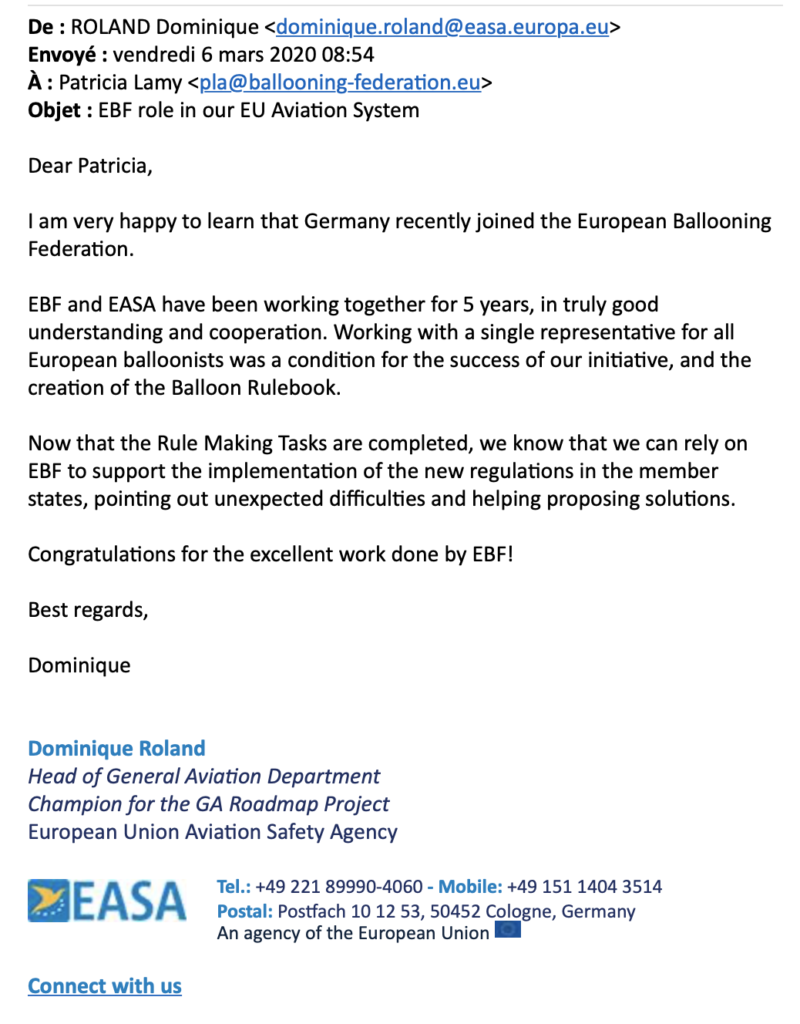
We are also very proud of the work done, during the last 5 years, with EASA.
As Dominique Roland, head of General Aviation at EASA, says:
Dear members,
Attached you will find the annual IAOPA and GAMMA enquiry for us to fill out.
The data will be used to get better insight in how much we use airspace at what annual cost and if we are happy with EASA and our NAA’s.
Please read the enquiry and we would like you to consider filling it out as soon as possible.
Karel
| After Austria, Belgium, Czech Republic, Denmark, France, Holland, Spain, Switzerland, and UK, we have the pleasure to welcome Germany, represented by the talented Willi Eimers, President of the ballooning section of the Deutscher Aero Club. We are certain that Germany will be a very important contributor to our work, and we warmly welcome the German balloonists. |  |